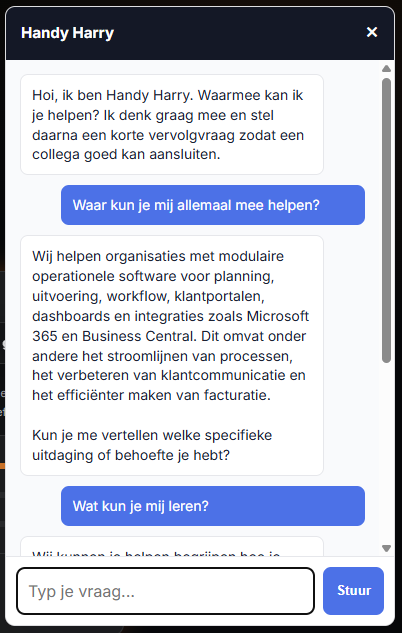
Handy Harry: a chat assistant that qualifies leads on its own
An AI chat widget that talks to visitors immediately, digs into what's really going on, and only then loops in a colleague — with a complete handoff file ready to go.
Context: Four SME websites (AppXperts, Oplossingfabriek.nl, Cloudtekkie, EffICT)
Across several websites, enquiries came in through a standard contact form: a name, an email address and a short message. That's where the real conversation had to start, because a colleague still had to figure out what the visitor actually needed, how urgent it was, and what situation was behind the request. Visitors asking a question in the evening or over the weekend got no response at all until someone was available.
The challenge wasn't simply to bolt on a chatbot. A chat assistant had to behave like an experienced intake specialist: calmly asking follow-up questions without being pushy, never promising prices or guarantees, and knowing exactly which brand it represented on each site — without ever mixing up companies from the same network. On top of that, the system had to keep working even without an active AI connection, so a technical hiccup would never leave a visitor stranded.
We built a lightweight chat widget that shows the same recognisable icon on every website, with a clear “Direct contact” label on hover. Behind the button sits an AI agent that gets its own knowledge source per website: a central, continuously updated knowledge document with that specific brand's services, frequently asked questions and safe conversation boundaries. The agent recognises which piece of context is still missing from the conversation and asks a targeted follow-up question about exactly that, instead of working through a fixed script.
The first version went live with one simple promise: never leave a visitor empty-handed. Without an active AI connection, the widget automatically fell back to a clean, fixed question so a lead was always captured. From there, the setup improved in small steps: first the connection to a real language model, then a richer knowledge document per brand.
The chat assistant now runs on four websites, each with its own voice and knowledge, but on the same underlying technology — including a strict “brand identity” rule so the assistant never accidentally starts talking about a different company from the network.
During rollout we ran into a subtle bug where the knowledge retrieval structurally leaned toward one brand. It only became visible once multiple brands were running on the same underlying technology — a good lesson that shared knowledge sources always need to be tested per brand, not just as a piece of technology in isolation.
The search logic was made dynamic per website instead of fixed, and the whole setup was deliberately built so a fifth or sixth website can join easily: just a new knowledge document and one line in the site configuration.
Recognise this kind of challenge?
We're happy to think along, from the very first idea to a working first version.
Other cases
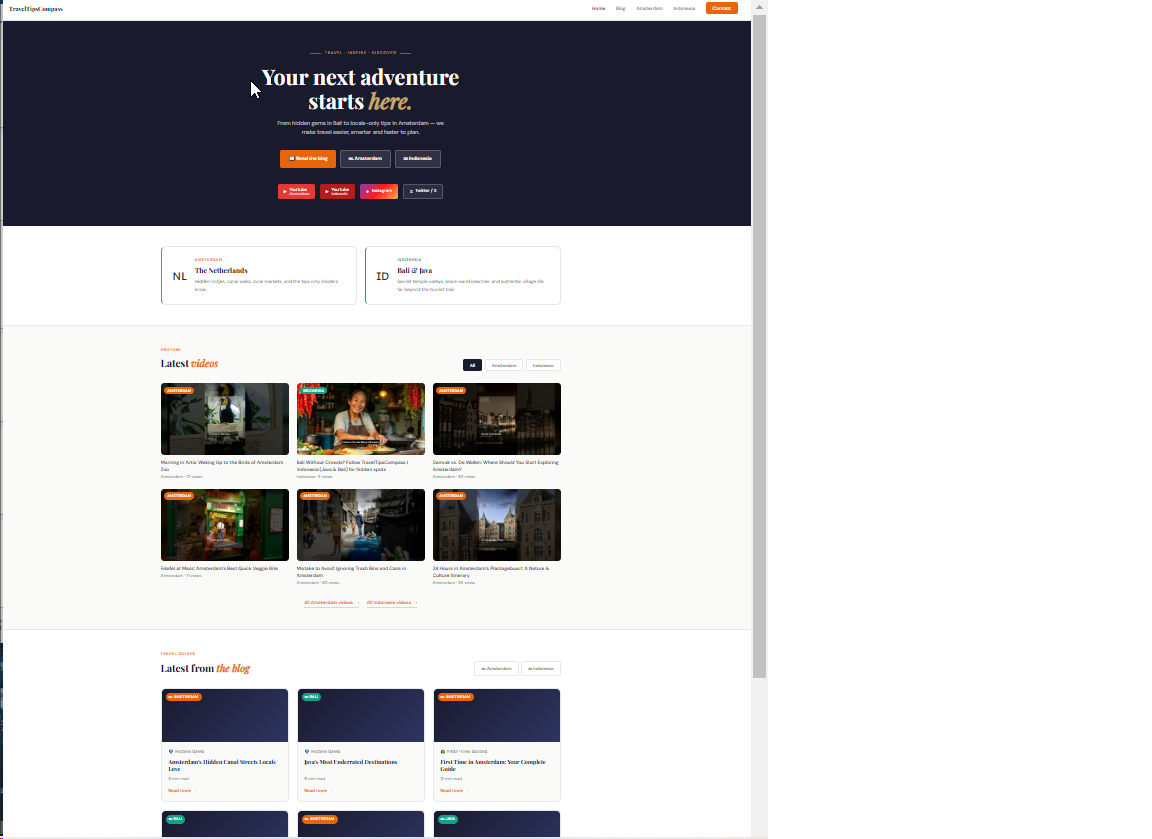
A content engine for TravelTipsCompass: from time-consuming juggling to automatic publishing
An agent that works from a content calendar, collaborates with the team, and ultimately prepares and publishes photos and posts across multiple channels on its own.
Read the case →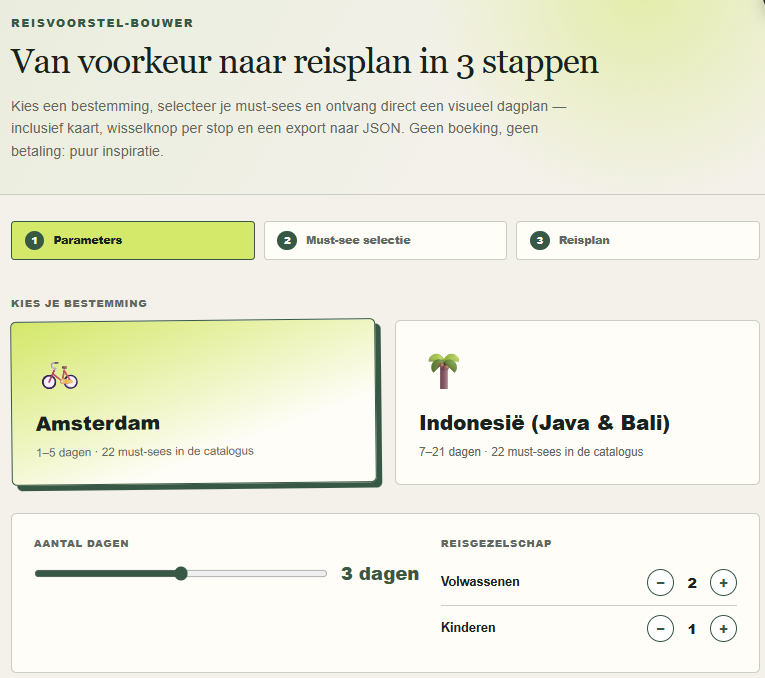
Trip Inspiration Planner: from decision fatigue to a trip plan in three steps
A web app that takes visitors from picking a destination to a complete, visual day-by-day plan in three simple steps — no booking involved, purely for inspiration.
Read the case →
Context-Aware POS: from 6 clicks to 1 tap during peak hours
A point-of-sale system that adapts to time of day and context, so ordering during a rush no longer feels like clicking through a complicated menu.
Read the case →